

“She wants to talk to you.”
I won’t paint the scene in detail, because the trauma of it isn’t only mine to share. Suffice it to say it was dire.
I reached my hand from the beneath the covers, took the phone, and held it to my ear. I don’t remember whether I said, “Hello.” Maybe it was just the noise of my muffled weeps and whimpers that told her I was listening.
“Holly,” said my therapist’s voice—kind and calm, but firm. “We’ve tried to put this off for as long as possible, but it’s time. You need to go to the hospital.”
I didn’t want—indeed I was terrified—to go, but I knew I’d rendered myself defenseless, and besides, I had no spark of energy left with which to fight. My body felt like boulders hung on yarn, but I managed to drag it from the bed, and I started packing.
What do you pack for the psychiatric hospital? I wasn’t sure. I didn’t know how long I’d be required to stay, much less what I’d be asked or allowed to do once I got there. One thing I did know, however, was that nothing good could come from me retreating to this alien place with only my thoughts to occupy me. So before I left, I grabbed three books: my Bible; an Advent devotional (in a week and a half it would be Christmas); and a little text, written by my favorite author, which I’d already read a few times before, but whose title concretized the message of which I knew my psyche needed most to be reminded—that is, Life Is a Miracle.
Through these hot, summer, dog days I’ve spent the bulk of my constructive energy creating and organizing homeschool curriculum and drafting an essay for print publication. My well of inspiration for Substack has felt dry, and it’s been a minute since I’ve written anything of length to post here. In the meantime, likely thanks to a couple light-hearted jokes I made over on Notes, I’ve gained a handful of new subscribers. (Hello, welcome!) As such, I figured whenever I did post again, I’d try to lean into the lighter, cheekier side of my voice as a writer.
Well, I finally found something to write about, and unfortunately it’s far from light and cheeky. To the contrary, this will possibly be the heaviest, most delicate post I’ve written to date. (Hello, welcome!—I hope you’ll stay, but I understand if you realize I’m not what you bargained for, and I wish you all the best if you feel the need to back out.)
If you’ve spent more than ten seconds on Substack over the past week, you’re certainly aware of two headlines: first, of the hotly-contested, criminal trial of Lindsay Clancy (which has now been declared a mistrial), and second, of the death of Wendell Berry at age 92 this past Monday. These two headlines converge to strike a particularly tender pain in my heart.
Virtually all who know me personally and most who read me occasionally know that the fabric of my story bears a dark stain representing a multi-year battle with severe, debilitating, and treatment-resistant postpartum depression. I don’t publicize the details of my symptomatic, depressive behaviors, because, having inhabited that state of illness, I know that reading the details of others’ behaviors can trigger those stuck in such a state to mirror them—perhaps especially when those details are presented as tragic, or even as wrong.
However, I will say this much: Much like Clancy’s, my illness developed gradually alongside the births of my three children. Also like Clancy’s, mine displayed both bipolar and psychotic tendencies and included intrusive, destructive urges that at times felt like they came from extra-personal sources. (I praise God, with everything in me, that my urges only ever pointed back toward myself and never toward my children or other loved ones.)
Like Clancy, I was diligent about seeking care and following the instructions of my providers. Unlike Clancy, I was blessed to work with a truly extraordinary team of Christian psychiatric and therapeutic professionals who always took me seriously, who went above and beyond to advocate for me, and who responded to my calls for help even outside work hours. Even so, it took years of trial and error with countless permutations of antidepressants, antipsychotics, and mood stabilizers (in addition to cognitive, emotional, relational, and spiritual counseling and a week-long hospitalization) before I found my way to stability. Until I miraculously found myself standing at the threshold of wellness—not long after hitting rock bottom—the journey mostly felt like one step forward, two steps back.
Finally, like Clancy, in my state of illness I thought things, said things, and did things—terrible things—which, in a state of mental clarity, I never would have imagined myself morally capable of, and which no one who has met me in any other context would imagine I could think, say, or do. I praise God, first, that my children were miraculously shielded from witnessing the worst of it, and, second, that the havoc I wreaked wasn’t mortal. Nevertheless, the body keeps score not only of traumas endured, but also of those inflicted, and mine still reels at the memories of the harm I caused. I suppose—even after healing, and even after forgiveness—it always will.
Before I continue any further, I want to acknowledge that criminal responsibility and criminal justice are not one and the same as moral responsibility and moral justice. Morality operates vis-a-vis the perfect wisdom of God, while criminality operates vis-a-vis the fallible wisdom of man. I don’t personally know enough about the Massachusetts criminal justice system to know what exactly is at stake in Clancy’s criminal case, nor have I drawn exact conclusions about what I believe the appropriate consequences for her actions should be. My argument to follow has less to do with the trial itself than it does to do with the discourse surrounding it.
Thousands of women have rallied around Clancy to advocate for her innocence, stating solidarity in their personal experiences with postpartum mood disorders and decrying the failure of America’s health systems to provide adequately for postpartum mothers seeking help. Clancy has been cast as a helpless victim of both natural causes and flawed human institutions—her actions cast as material inevitabilities rather than as conscious choices. The conversation has revolved almost entirely around the mother’s circumstances and the people and systems that failed her.
Strikingly absent from the discourse is the recognition of the three children whose decaying bodies now lie cold in their graves. Cora was 5—the age at which my oldest learned to play “Twinkle, Twinkle, Little Star” on the piano. Dawson was 3—the age at which my middle son could identify all the states in our America puzzle. Callan was 8 months—the age at which my youngest made it clear that he would be our family’s resident class clown. Cora, Dawson, and Callan are dead, because their mother killed them—three precious, innocent lives, cut short by horrific violence.
Virtually everyone who knows me personally and most who read me occasionally also know that my thoughts and my writing have been profoundly shaped by the work of Wendell Berry. I would go so far as to say that his writing has not only changed, but even saved my life. The past week has made it clear that I’m far from alone in this; by now I’ve scrolled through hundreds of tributes both here on Substack and in other online publications stating exactly as much.
There is so much I could say to reflect on Berry’s work and the ways it has shaped me; in fact I have multiple times elsewhere here on Substack (for example, here and here). I could comment on his thoughts about work, community, propriety, loyalty, familiarity, economy, or humility—all of which are profound and prophetic. However, here I will focus on his pacifism.
To many in this day and age, the word pacifism reads as soft, mushy, and out of touch with reality. Of course everyone wants world peace, but realistically..? Indeed, perhaps the most popular complaint made against Berry’s work is that the standards he endorses, whether regarding pacifism, conservationism, technology, or economy, are unrealistic. I felt the same when I first started reading him, and it wasn’t until I pushed through and kept on reading that the value of his wisdom grabbed hold of my heart. This is precisely why the world needs prophets like Berry—those willing to stand outside the status quo, outside the partisan politics, and outside the pre-packaged, institutional solutions to call us to a higher standard.
Berry’s pacifism, furthermore, is informed by rather than ignorant of the realities of war. Nowhere is this made clearer than in “Okinawa”—the chapter of his novel Hannah Coulter in which Hannah reflects on her husband Nathan’s experience fighting in the Battle of Okinawa during World War II. It’s a graphic chapter, one I wish I could quote in full to project its full impact, but for now I’ll limit myself to this:
You can’t give yourself over to love for somebody without giving yourself over to suffering. You can’t give yourself to love for a soldier without giving yourself to his suffering in war. It is this body of our suffering Christ was born into, to suffer it Himself and to fill it with light, so that beyond the suffering we can imagine Easter morning and the peace of God in little earthly homelands such as Port William and the farming villages of Okinawa.
But Christ’s living unto death in this body of our suffering did not end the suffering. He asked us to end it, but we have not ended it. We suffer the old suffering over and over again. Eventually, in loving, you see that you have given yourself over to the knowledge of suffering in a state of war that is always going on. And you wake in the night to the thought of the hurt and the helpless, the scorned and the cheated, the burnt, the bombed, the shot, the imprisoned, the beaten, the tortured, the maimed, the spit upon, the shit upon.
The Battle of Okinawa was not a battle only of two armies making war against each other. It was a battle of both armies making war against a place and a people. …
And their beloved, lovely island was scoured and burned. Everything standing was destroyed: houses, trees, gardens, tombs, towns, the capital city of Naha, the beautiful castle of Shuri. I found books with photographs of beautiful buildings, walls and gates, bridges and gardens, all “destroyed in 1945.” I found a photograph of some tanks driving across little fields, leaving deep tracks.
I began to imagine something I know I cannot actually imagine: a human storm of explosions and quakes and fire, a man-made natural disaster gathering itself up over a long time out of ignorance and hatred, greed and pride, selfishness and a silly love of power. I imagined it gathering up into armies of “ignorant boys, killing each other” and passing like a wind-driven fire over the quiet land and kind people. I knew then what Nathan knew all his life: It can happen anywhere (pp. 171–72).
Here is a statement that should not be controversial: For a human to harm or destroy innocent life is always an act of evil.
Here is another statement that should not be controversial, but is nevertheless hard to swallow: The vast majority of evils perpetrated on this earth are carried out not by those we’d readily identify as “monsters,” but by normal people—people with “mitigating circumstances,” people “simply carrying out orders,” and people very much like you and like me. It could happen anywhere—and I could be the one to do it.
None of us want to believe this about ourselves, and this is precisely why so many women have flocked to Lindsay Clancy’s side to declare her innocence. She was a loving and devoted mother, just like us! And we would never make the conscious choice to murder our children, so it must have been insanity that forced her against her will to do what she did.
At first this might read as a message that would comfort mothers struggling with postpartum psychosis. Whatever you do, it’s not your fault! However, having experienced postpartum psychosis myself, I want to state emphatically that when I was in a psychotic state, it would have utterly terrified me to read of a mother being declared innocent after performing such heinous acts of violence. The message I would have heard is this: Your intrusive thoughts will win. It’s inevitable. You have no choice in the matter. This is not a comfort. To strip a mentally ill person of their moral agency is dehumanizing and disabling. It’s to strip them of their identity as image-bearers of a loving God, and to convict them as animals, inevitably subject to their violent instincts.
As I’ve already mentioned—I thought, said, and did terrible things when I was ill. More to the point, I thought, said, and did evil things when I was ill, insofar as my urges promoted the harm and destruction of life. In retrospect, I can recognize that—absolutely—my cognitive and emotional faculties were severely compromised at the time. Nevertheless, I stand firm in the declaration that I was not forced to do anything I did; I made my choices consciously, and I bear full responsibility for them.1
Pacifism, Berry’s work makes clear, is not merely a question of “To war, or not to war?” Rather, it informs all his thoughts, whether related to community or to industry. Consider the following, from Life Is a Miracle:
It is not easily dismissible that virtually from the beginning of the progress of science-technology-and-industry that we call the Industrial Revolution, while some have been confidently predicting that science, going ahead as it has gone, would solve all problems and answer all questions, others have been in mourning. …
What were they afraid of? What were their “deep-set repugnances”? What did they mourn? Without exception, I think, what they feared, what they found repugnant, was the violation of life by an oversimplifying, feelingless utilitarianism; they feared the destruction of the living integrity of creatures, places, communities, cultures, and human souls; they feared the loss of the old prescriptive definition of humankind, according to which we are neither gods nor beasts, though partaking of the nature of both. What they mourned was the progressive death of the earth (pp. 75–76).
Destruction is now the norm. Exploitation is now the norm. Murder is now the norm. This is the case not because the world has increasingly been filled with “monsters.” Rather, it’s the case because normal people have become so entitled to convenience and comfort, we’re willing to avert our eyes from the people whom and things which we are trampling in order to acquire what we want. Like Lindsay Clancy’s supporters, we deny our moral agency, claiming instead that we are merely products of our circumstances and our cultures—and it must therefore be the circumstances and the cultures that are to blame.
What then is the solution? The lot of Berry’s work pleads again and again: what the world needs now is to be reminded and convinced that life is indeed a miracle. The only cure for the selfish ambition that hurdles our earth and its inhabitants toward destruction is an imagination that breeds compassion. Take, again, Hannah Coulter:
As many who have known it have said of it, war is Hell. It is the outer darkness beyond the reach of love, where people who do not know one another kill one another and there is weeping and gnashing of teeth, where nothing is allowed to be real enough to be spared.
Hell is a shameful place, and it is hard to speak of what you know of it. It is hard to live in Port William and yet have in mind the blasted and burnt, bloodied and muddy and stinking battlegrounds of Okinawa, hard to live in one place and imagine another. It is hard to live one life and imagine another. But imagination is what is needed. Want of imagination makes things unreal enough to be destroyed. By imagination I mean knowledge and love. I mean compassion. People of power kill children, the old send the young to die, because they have no imagination. They have power. Can you have power and imagination at the same time? Can you kill people you don’t know and have compassion for them at the same time?
Destruction-oriented mental illness is also Hell, and those who struggle with it tend to encounter two messages. One message tells them that they are monsters, that they are gravely condemned with guilt before God and man. (When I was ill, I believed the Nirvana lyric to be true of myself: Jesus doesn’t want me for a sunbeam.) The other message tells them that they are guiltless—mere victims of their brain chemistry and mitigating circumstances.
Both of these messages are onto something, but neither, in the end, is helpful. What is needed, rather, is one who will encourage the lost: You are a miracle, not a monster. Recognize yourself as such. Likewise, your body and your loved ones are miracles, not burdens. Treat them as such.
What is needed is an advocate who will comfort and admonish, “Neither do I condemn you. … Go now and leave your life of sin” (John 8:11).
No matter what ends up happening to Lindsay Clancy vis-a-vis the legal system, I hope she will in some way experience the grace and mercy of a loving God. However, grace is a gift that can only be received by the humble, not by the entitled; and mercy is a gift that can only be received by the remorseful, not by the proud. God disciplines his children, and we do well to accept the consequences he prescribes us.
The horrific story of the murders of Cora, Dawson, and Callan Clancy at the hands of their mother should humble us all. For those of us who have lived most of our lives in comfort, with relatively easy access to the things we want and need, the suggestion that we could commit atrocious violence strikes not only as impossible, but also as offensive. Only complete insanity, we tell ourselves, could drive us to such acts.
Most of us would be surprised, however, to face the reality of how little it might take to convince us to trade our moral compasses for comfort and convenience. Indeed, if we’re honest with ourselves, we should all be willing to confess that we are to some degree complicit in the violent injustices that contribute to Creation’s groanings. Our enemy the devil “prowls around like a roaring lion, looking for someone to devour” (1 Peter 5:8), and when we make excuses for the injustices we commit or for those committed by others, we actively feed the lion.
But there is good news here. A Savior stands ready not only to forgive the repentant, but also to grant hearts of flesh to those with hearts of stone. He promises to send his Spirit to those who ask, and the Spirit is both willing and able to bring light to our darkness, warmth to our coldness, and compassion to our self-preservation and self-promotion. He is the Lord of life and the Master of miracles, and he wants to see you flourish in righteousness and justice.
Christ, have mercy on us. Deliver us from evil.
Matters of Late
Not much new to share either on the writing front or on the art front, as I’ve been busy preparing for my kids’ homeschool year, but I did write a piece (about the glorious, chaotic humanity of Facebook Marketplace) that should be coming out through Common Good Magazine later this year. Stay tuned!
Giveaway
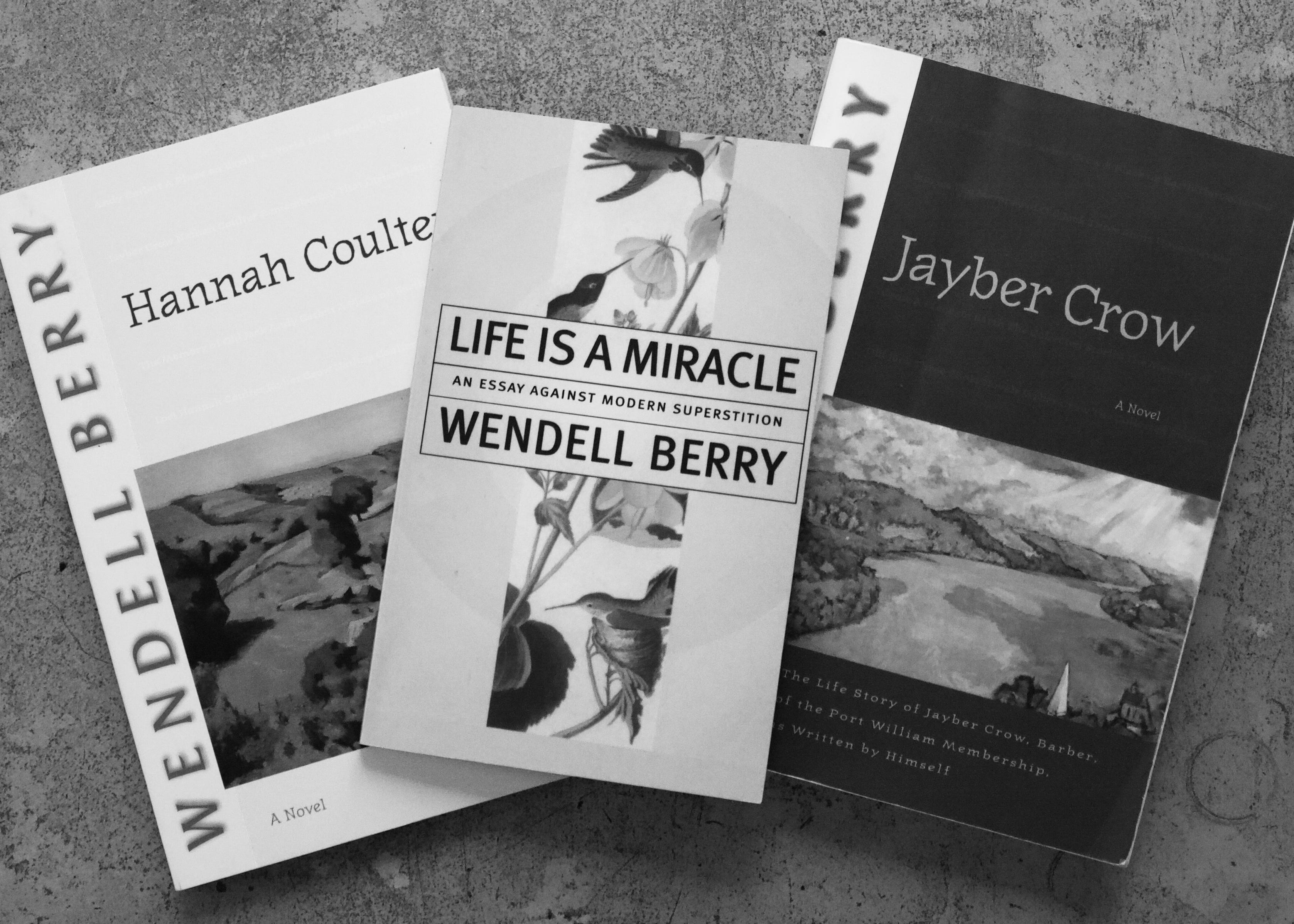
If you’re new here, you may not be aware that in addition to writing, I also create and sell linocut artwork, and typically, with each of my newsletters, I offer one of my linocut prints as a giveaway. This month, however, in Berry’s memory, I would like to order one out of three of his books to be mailed to one of my readers. (Now that he’s gone, I feel as passionate as ever about contributing to the perpetuation of his legacy.) The three choices will be as follows:
Jayber Crow: Perhaps Berry’s most famous and well-regarded novel. At 363 pages, it’s not a light read, but it offers perhaps the most thorough representation of Berry’s spectrum of thought on a variety of topics. It will likely break your heart and change your life.
Hannah Coulter: A great place to start if you’d like to become acquainted with Berry’s fiction without overcommitting yourself. (At 186 pages, it’s a relatively quick read.) I’ve many times said that the character of Hannah is the best, most realistic “woman written by a man” I’ve ever encountered in a book.
Life Is a Miracle: For those who prefer nonfiction over fiction. The book is short (153 pages), but fairly dense and academic. Despite what the title might suggest, it is not by any means a sentimental work; however, I’d argue that it’s all the more inspiring for the degree to which it engages complex and difficult thoughts. It’s a good representation of the message promoted by a line from Berry’s poem “The Mad Farmer Liberation Front,” which I’ve seen quoted a couple dozen times this week: “Be joyful though you’ve considered all the facts.”
Click the button below and fill out the form by Sunday, September 6, if you’d like to be entered in the drawing. Note that this giveaway is only open to subscribers, so if you haven’t yet subscribed, make sure to do so first (subscribing comes with a couple other perks too!).
Thanks for reading! Until next time—
Holly
Alan Noble presents a phenomenal description of the paradoxes of will at work in the mentally ill in his little book, On Getting Out of Bed: The Burden and Gift of Living (IVP, 2023). If you are struggling—or love someone who is struggling—in this area, I can’t recommend this book highly enough. You can likely finish it in one sitting, and your heart will be changed.
Holly, thank you for trusting your readers with something this heavy. I really appreciated your point about how telling struggling mothers they have "no choice" can actually feel terrifying rather than comforting. It's a terrifyingly thin line between grace and stripping someone of their agency.
Thank you for sharing, Holly.